

0
Donors
0
Team Fundraisers
"I am lucky that Taking Flight are for children like me. I have a fun time there. We all enjoy it and learn a lot. They teach us a lot of different things. We are leaning how to be great actors and have lots of fun the same time. I want a lot of children to be there and to have the same chance we have” Jemila, 14
Deaf children in Wales have been cut adrift by the closure of Deaf schools and the loss of "teachers of the Deaf". Arts provision for Deaf young people here is non- existent. Historically, Welsh Deaf children have been discouraged from using British Sig Language. A whole generation is in danger of losing their Deaf identity.
Deaf children are much more likely to suffer from loneliness and isolation from their peer groups. 2/3 of Deaf children describe themselves as "friendless"- let's think about that for a moment. That's MOST Deaf children living in the UK who consider they have not one single friend. If schools are places of isolation, where do Deaf young children go to make connections? One parent described how her son tried to go to Cubs, but the noise levels were so high that he coudn't cope with the sessions as his cochlear implants were amplifying the wrong sounds. He became confused about the activities and felt that no one wanted to make friends with him, and eventually he left.
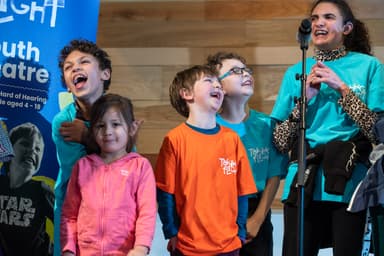
Taking Flight Youth Theatre is a Deaf led project, inviting Deaf and Hard of Hearing children in Wales to participate in free weekly drama workshops in BSL and English. This is a place where Deaf children can meet up, communicate freely in their chosen method without judgement or feeling "different", play and learn new skills. As a result we see huge increases in confidence, improvements in focus (we've only been running since Jan 2020 and before we went into lockdown, we had received some teacher feedback via a parent asking what had happened to improve their 5 year old sons concentration so drastically) and increased mental wellbeing.
Having access to a Deaf role model - a performer with her own company- is key. Our young people see Steph achieving and as a result, their own aspirations and those of their parents, are lifted (in a study, NDCS quoted lack of adult aspiration being a key disadvantage for Deaf children). In addition, we bring in other leading Deaf creative professionals to work wth the young people, so they see a range of Deaf people- including Deaf people of colour- achieveing and leading. (aroud 50% fo our young people are not white and it is important to us that the role models we provide are representative)
During the COVID pandemic, we have not only been inviting children to weekly meet up sessions online, but Steph and Anna (the YT assistant) have been creating weekly resources in BSL and English with captions, to fill the gap in accessible provision for Deaf children. One Mum said at one of the weekly sessions that she hadn't heard her daughter "laugh like this in a long time".
Deaf children in Wales have been cut adrift by the closure of Deaf schools and the loss of "teachers of the Deaf". Arts provision for Deaf young people here is non- existent. Historically, Welsh Deaf children have been discouraged from using British Sig Language. A whole generation is in danger of losing their Deaf identity.
Deaf children are much more likely to suffer from loneliness and isolation from their peer groups. 2/3 of Deaf children describe themselves as "friendless"- let's think about that for a moment. That's MOST Deaf children living in the UK who consider they have not one single friend. If schools are places of isolation, where do Deaf young children go to make connections? One parent described how her son tried to go to Cubs, but the noise levels were so high that he coudn't cope with the sessions as his cochlear implants were amplifying the wrong sounds. He became confused about the activities and felt that no one wanted to make friends with him, and eventually he left.
Taking Flight Youth Theatre is a Deaf led project, inviting Deaf and Hard of Hearing children in Wales to participate in free weekly drama workshops in BSL and English. This is a place where Deaf children can meet up, communicate freely in their chosen method without judgement or feeling "different", play and learn new skills. As a result we see huge increases in confidence, improvements in focus (we've only been running since Jan 2020 and before we went into lockdown, we had received some teacher feedback via a parent asking what had happened to improve their 5 year old sons concentration so drastically) and increased mental wellbeing.
Having access to a Deaf role model - a performer with her own company- is key. Our young people see Steph achieving and as a result, their own aspirations and those of their parents, are lifted (in a study, NDCS quoted lack of adult aspiration being a key disadvantage for Deaf children). In addition, we bring in other leading Deaf creative professionals to work wth the young people, so they see a range of Deaf people- including Deaf people of colour- achieveing and leading. (aroud 50% fo our young people are not white and it is important to us that the role models we provide are representative)
During the COVID pandemic, we have not only been inviting children to weekly meet up sessions online, but Steph and Anna (the YT assistant) have been creating weekly resources in BSL and English with captions, to fill the gap in accessible provision for Deaf children. One Mum said at one of the weekly sessions that she hadn't heard her daughter "laugh like this in a long time".
What your gift could provide
£20
A theatre ticket for 1 Deaf young person to be taken (post covid) to see inspiring Deaf lead theatre
£50
An hour of online youth theatre provision during pandemic for 6 Deaf children
£100
2 hours of real life (post Covid) youth theatre for up to 40 young Deaf people