
Community Story: The Sea We See
"Marine conservation education helps people see the ocean for what it truly is: a living, breathing system that keeps us alive. Not a resource to exploit, not a bottomless bin, but a miracle of planetary engineering that deserves respect, protection, and wonder."
Earth’s original life‑support system
For our latest feature connecting with an awardee of a grant from the Eastern Green Link 1 (EGL1) England Local Community Fund from National Grid Electricity Transmission we are spending some time with The Sea We See. This fantastic CIC is dedicated to promoting ocean literacy and marine stewardship through education, advocacy, and action. Our own Luke Upton caught up one of their Directors, Georgina Fuller to find out more about their fantastic work with communities in the North of England.
Luke Upton (LU): Thank you for speaking today, Georgina. Can we kick off by you telling our community about the importance of education around marine conservation. And why this is becoming increasingly important.
Georgina Fuller (GF): My pleasure. Education around marine conservation is becoming essential because people are only just beginning to understand how deeply the ocean underpins life on Earth. Ever since films like David Attenborough’s The Blue Planet brought ocean science into living rooms, more people now recognise that tiny plankton — not forests — produce around 60% of the oxygen we breathe. A healthy ocean creates more oxygen than any terrestrial source, and that single fact alone should make marine education a global priority. If the ocean can’t function properly, it can’t produce oxygen. And without oxygen, nothing else matters.
But the ocean gives us far more than oxygen. It stabilises our climate. It drives the water cycle that creates the fresh water we rely on. It shapes the land we live on and the coastal zones we depend on. It is, quite literally, Earth’s original life‑support system — the reason this planet became habitable in the first place. When people understand that, they start to see the ocean not as a dumping ground or a backdrop for holidays, but as something awe‑inspiring, fragile, and vital.
And here’s the uncomfortable truth: we’ve visually explored less than 1% of the ocean floor, yet we already know that many once‑abundant species are in serious decline. When keystone species disappear, ecosystems unravel. When pollutants from farmland and sewage systems create algal imbalances, plankton suffer. And when plankton suffer, oxygen production drops. It’s all connected — but most people don’t realise how tightly.
That’s why education matters. Because without understanding, people fall back on old habits: “It’s fine, the ocean will take it away.” It won’t. Whatever gets “taken away” gets taken into the system — and it kills, silently and efficiently.
Marine conservation education helps people see the ocean for what it truly is: a living, breathing system that keeps us alive. Not a resource to exploit, not a bottomless bin, but a miracle of planetary engineering that deserves respect, protection, and wonder. And as pressures on the ocean increase — pollution, warming, overfishing, habitat loss — the need for that understanding becomes more urgent every single year.
LU: That’s a wonderful introduction. Thank you. Can you share some of the feedback and impact you’ve seen from the young people you engage with?
GF: The feedback from the young people has honestly been one of the most powerful parts of this whole journey. What we’re seeing is that the learning doesn’t just stay in the classroom. They’re carrying it with them, and they’re choosing to act on it.
The feedback is always positive, from beach based science sessions to interactive stalls at carnivals, those engaged love to know more about their coastline, feel a need to taking action. Adults usually leave with statements like “I didn’t realise”, “I’m not doing that again” and “wow, I’ve learned something today”
I have recently been asked to organise nurdle picking activities for home educated children, where we will learn about the life of a nurdle and the impact it has if it strays from its path. This was a request from one of my regular learners.
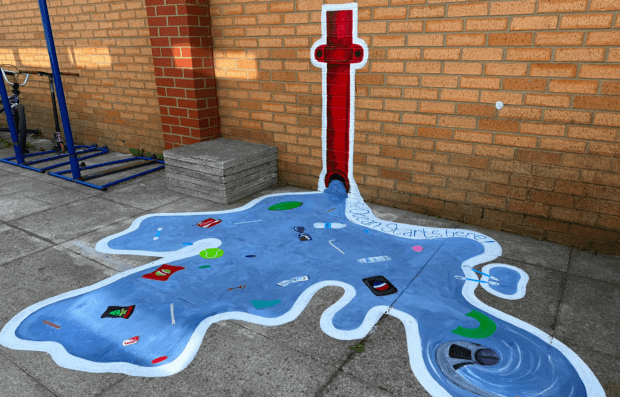
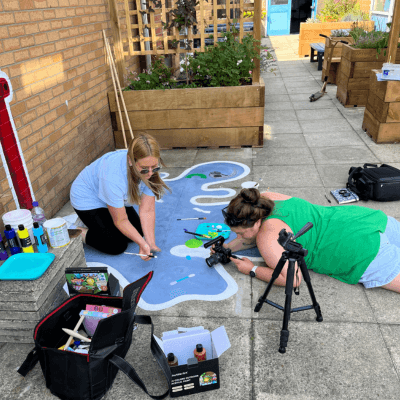
A brilliant example of the impact of our work, is the new youth‑led project, The Sea Starts Here, created at a youth club by the artist who worked with us on The Ocean Starts Here! It’s all about cleaning up a rundown shopping centre next to the school where we recently delivered The Ocean Starts Here. This new project further celebrates how close the community is to the beach. The fact that children from the school are now turning up at the youth club specifically to support her on this project shows just how much the message has landed. They’ve gone from “this is interesting” to “let’s do more”
The impact is visible. They’re showing up. They’re volunteering. They’re bringing friends. They’re talking about pollution, about the beach, about the shopping centre, about how small changes ripple outward. They’re starting to understand that their actions matter — and they’re choosing to be part of something bigger than themselves. They believe they are connected to the ocean and it to them.
We are an island nation and our ocean needs all the help we can get it
LU: You’ve just received funding from the Eastern Green Link 1 (EGL1) England Local Community Fund from National Grid Electricity Transmission and Localgiving. Can you tell us some more about the project, what it will help fund and what it aims to deliver.
GF: The project is about being connected to the ocean - believing that the ocean passes through you and starts with you. We visited a school five times and took ocean science and art and combined the two to make immersive learning experiences for 37 Year 5 students. We helped them connect the dots from their school to the sea, their place in the water cycle the amazing creatures and the damage our daily life does. We created lots of art, a mural in their school grounds and took them to the beach for more art and rock pooling. Their art, stories and questions fed into a picture book and a story that will be professionally printed for them to keep, and a promotional learning video created for the school to use in future assemblies, on their web site and more. I will return to the school one last time in the new term to present the video, books and officially “open” the art work.
A very big thank you to National Grid Electricity Transmission for supporting us with the Eastern Green Link 1 (EGL1) England Local Community Fund. The project will leave a legacy in the school that can be shared with learners for many years to come, each child has a book to take home and share their learnings with their families. The official publication of this book will support other schools, youth groups and families as they will have access to the story and the message behind it. 20% of the proceeds from the book will go towards supporting ocean connection and conservation education at all levels.
LU: How important is this kind of grant funding to your organisation?
GF: We do our best work when we can obtain funding, schools struggle to pay for even 1 visit from The Sea We See CIC and we are not what I would consider expensive, but larger organisations like the wild life trust, will offer activities for free from the massive funds they acquire. So, for us to get our messages out there , grants and sponsorships are the best way. Ocean conservation and education is not firmly on the priority list when it comes to budgets. So again a big thank you to National Grid and Localgiving for their timely support this year.
The iGCSE in Marine Science isn't available in schools because of a coding technicality. However it would appear that when the rivers, lakes and seas are talked about, it is often around drowning, the learners come away frightened of the waterbodies and no one wants to protect something they are scared of. This is sad, but we keep pushing our message, because we are an island nation and our ocean needs all the help we can get it.

"The ocean needs to be talked about, learned about and understood. We need to have our communities wanting to learn not frightened and turning their back on it."
Help people understand the ocean, rivers and seas.
LU: As we always ask our interviewees, more money aside, what would help you most?
GF: The ocean needs to be talked about, learned about and understood. We need to have our communities wanting to learn not frightened and turning their back on it. I want to help people understand the ocean, rivers and seas. As a wild swimmer and open water swimming lead I would like to be able to teach swimming in the sea or in a river, to encourage the safe and sustainable use of these blue spaces. This work needs powerful promotion, throughout industries and schools the connection need to be made, the fear removed and the drive to protect nurtured.
LU: Thank you so much for sharing today, sounds like a really busy, exciting time.
GF: Absolutely. We hope to launch a CPD that will present The Ocean Starts Here learning at a higher level, September will see Float our beach based swimming lessons launch into the wonders of winter swimming and the book from The Ocean Starts here will be available to purchase. We are excited for the coming months. Thank you for helping make so much possible.
LU: Brilliant, keep up the fantastic work!
Find out more about The Sea We See CIC by clicking here.
You may also be interested in:
About Localgiving
Localgiving is a leading online fundraising platform and grant delivery partner, focused on supporting small charities, CICs and community organisations. Since 2010, we've helped thousands of groups across the UK raise tens of millions of pounds and make a meaningful impact in their local communities.
Our platform offers an easy-to-use suite of powerful fundraising tools alongside AI-powered support for finding and applying for grants—equipping organisations with everything they need to grow and succeed.
We also collaborate with major partners, including National Grid and Scottish Power, to deliver corporate grant programmes and connect funding with the communities that need it most.
Join Localgiving today and unlock new opportunities to supercharge your fundraising.
---> Get started with Localgiving with our free 14-day trial